Course
Study programs
Medical Studies in EnglishYear of study
5ISVU ID
224954ECTS
3.5
Student assessment is carried out in accordance with the current University of Rijeka Study Regulations and the Student Regulations at the Faculty of Medicine Rijeka (adopted by the Faculty Council of the Faculty of Medicine Rijeka). Students' performance will be evaluated during the course and at the final exam. Out of a total of 100 credits, a student can earn 50 credits (50%) during the course, and 50 credits (50%) at the final exam. Student assessment is performed using ECTS (A-E) and number system (1-5). Student assessments in ECTS system is carried out by is performed by absolute distribution, and according to graduate assessment criteria. Out of a total of 50 credits that can be earned during the course, student must earn minimum 25 credits to take final exam.
I. During the course (maximum 50 credits):
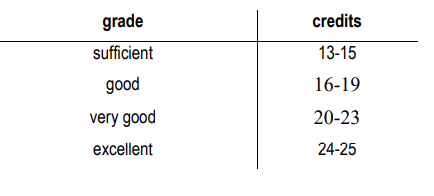
Obligatory colloquium I and II test (maximum up to 25+25 credits) During the course all students must take obligatory first colloquium earning maximum 25 credits (range 13-25 maximum). During course all students must take second obligatory colloquium aswell earning maximum 25 credits (range 13-25)
II. Final exam (maximum 50 credits):
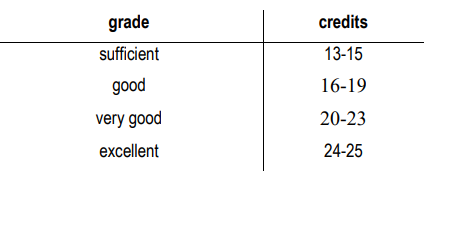
Final exam consists of obligatory written exam on Merlin platform in the form of essay. Student who earn 25 or more credits during the course can take final exam. Student who earn less than 25 credits during the course cannot take final exam. Final exam is scored maximal up to 50 credits. Final exam consists of 5 questions and brings 50 credits (range 25-50). To earn the credits student must pass 50% of final test. Correct answers are converted in credits by the following criteria:
For a passing grade during classes and on the final exam, student has to obtain minimum of 50 credits.
The ECTS grading system is defined by the following criteria: A - 90 -100% credits B - 80 - 89,9% credits C - 70 - 79,9% credits D - 60 - 69,9% credits E - 50 - 59,9% credits Grades in ECTS grading system are converted in numerical system by the following criteria: A = excellent (5) B = very good (4) C = good (3) D = sufficient (2) E = insufficient (1)
| Academic year | |
|---|---|
| 2026/2027 | Preuzimanje |